
|
Petro-Canada - Alf
Peneycad
Taking
Care Of Business At Canada's Gas Station
Petro-Canada's
Business Plan envisages major growth of its asset base. To fund
this growth, the company has announced that it is selling off most
of its oil assets in Western Canada. Other large oil and gas companies
such as Imperial Oil and Shell are also doing the same, and leaving
western-based exploration to medium-sized companies. Petro-Canada
is the largest Canadian-owned "integrated" petroleum company in
the country. The industry typically divides its business into "upstream"
for exploration and extraction, and "downstream" covering businesses
ranging from refining to consumer and business sales.
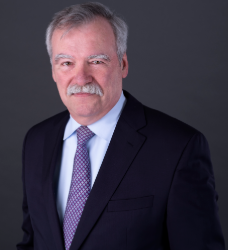
W.A.N.
(Alf) Peneycad has directed his legal services team and outside
counsel through large projects in recent years. The most noteworthy
have been the Hibernia and Terra Nova projects on the Grand Banks.
At times, Petro-Canada collaborates with Mobil, Imperial Oil, Chevron
and Shell for such capital ventures. In cases such as Terra Nova,
the company also operates the project for the other participants.
A quick review of Canadian mega-projects and the company's growing
activity internationally, reveals that the law department's domestic
and international trans-national legal work shows no signs of slowing
down.
Petro-Canada
likes to call itself "Canada's Gas Station" and is committed to
continual growth combined with efficiency improvements. As one of
only three retailers that are national, the others being Shell and
Imperial Oil, Petro-Canada in large part has grown by acquisition.
Initially promising negotiations with Ultramar and Suncor, however,
did not prove successful over the course of the last two years.
Nevertheless, the company's new image stations in urban markets
have delivered financial results significantly in excess of industry
averages. The combination of large capital projects and retail activity
requires a mastery of the full range of legal services that Alf
Peneycad and his team have successfully provided to the company.
Title:
Vice-President and General Counsel
Age:
54
The
company: Privatized in 1991, Petro-Canada has revenues ranging
from $5 billion to $6 billion, depending on the year. Capital investments
were in the range of $1 billion for 1999, with one-quarter in the
natural gas portfolio in Western Canada, and 40 per cent to develop
and explore offshore Newfoundland. The Syncrude oil sands investments,
and interests in Algeria, Norway and Tunisia are also significant
components of the portfolio.
Principal
Outside Counsel: The company uses formal strategic alliances
with Fraser Milner (Calgary), Miller Thomson LLP (Toronto), Patterson
Palmer Hunt Murphy (downstream in Atlantic Canada), and a combination
of Chalker, Green & Rowe (now McInnes Cooper) and Stewart McKelvey
Sterling Scales for the upstream work involving Hibernia.
Principal
Outside Counsel: The company uses formal strategic alliances
with Fraser Milner (Calgary), Miller Thomson LLP (Toronto), Patterson
Palmer Hunt Murphy (downstream in Atlantic Canada), and a combination
of Chalker, Green & Rowe (now McInnes Cooper) and Stewart McKelvey
Sterling Scales for the upstream work involving Hibernia.
The
Law Department: The department has 16 lawyers, 9 paralegals
and 11 other support employees. The majority are in Calgary, but
there are two department members in Montreal and two based at the
Oakville facilities. Because acquisitions (including Petrofina,
BP, Gulf and Amerda Hess Canada) and growth over the years, the
law department has a broad range of experience. Outside counsel
are used for particular expertise such as tax, competition or labour
law, when volumes of legal work suddenly increase, or when there
are geographic considerations such as environmental or real estate
work, which make it more cost effective to use local counsel.
The
Calgary members of the law department work from a central location,
but are responsible for specific business units. The department
is well regarded by its internal corporate clients and is well-positioned
within the company.
Litigation:
Most of the company's litigation concerns real estate and environmental
matters, and for that reason, emanates from the downstream half
of the company. Matters will often be co-counseled with much of
the preparatory work handled by members of the law department. Pleadings
will often be referred to outside counsel. Petro-Canada is a charter
member of the Canadian Foundation for Dispute Resolution.
Transaction:
The company's business plan calls for several large transactions
each year. The oil sands, divestiture of low yield western oil properties,
and growth in Canada's offshore and in Algeria, Tunisia and Norway
have been prime examples.
Management
Challenge: With the unit costs of external legal services growing
by at least 10 per cent each year, the greatest challenge is to
introduce successful cost control mechanisms, while still encouraging
strategic alliances with outside counsel.
Corporate
Objectives: Alignment with Petro-Canada's goals is straightforward
because the department's lawyers are responsible for specific business
units. Last year, 140 of the law department's internal "clients"
were asked to submit anonymous evaluations. The response rate was
over 95 per cent. Alignment is the number one objective, to the
point where a substantial portion of the lawyer's discretionary
compensation depends on the success of their business unit and the
corporation.
Improving
Outside Counsel: An important concern is that major firms are
not sufficiently aggressive in their use of technology to become
more cost effective. The relationships should be pushed forward.
Firms could do much more to introduce best practices in law departments.
U.S. firms likely have more exposure to hi-tech clients, fuelling
the firm's progress along the technology continuum.
Style:
Alf is acknowledged as being results-oriented. His department members
and clients would say that "he is not like other lawyers" as he
is prepared to step out of the norm where necessary. He is credited
with building a strong law department and enduring relationships
with law firms.
Career:
After 7 years in private practice in Toronto, Peneycad joined
BP Canada in 1979 as head of the Real Estate and Business Development
department and Marketing solicitor for Ontario. He was promoted
to General Counsel in 1981. Petro-Canada acquired BP in 1983 and
Alf moved to Calgary in 1985 to become Assistant General Counsel
responsible for the downstream company. By 1996 he was General Counsel,
and became Vice President in 1997. Today, he celebrates more than
20 years of working in-house for the oil and gas industry.
Family:
Married to Fiona, and has two daughters, Andrea and Ashlyn
Currently
reading: The History of Leaside, one of Canada's first
planned communities; The Creature from Jekyll Island: A Second
Look at the Federal Reserve, and The Soul of Golf.
Relaxing:
Alf takes 4-5 day mini golf trips. He is now planning a serious
golf excursion in Ireland.
Richard
G. Stock, M.A., FCIS, C.ADM., CMC, is a partner with Catalyst Consulting,
a firm with offices in Montréal, Toronto and Vancouver. Catalyst Consulting
has been designated the Preferred Supplier for Legal Services Consulting by
both the CBA and the Canadian Corporate Counsel Association.
|